 PrimePatio
Outdoor lighting that survives its first winter
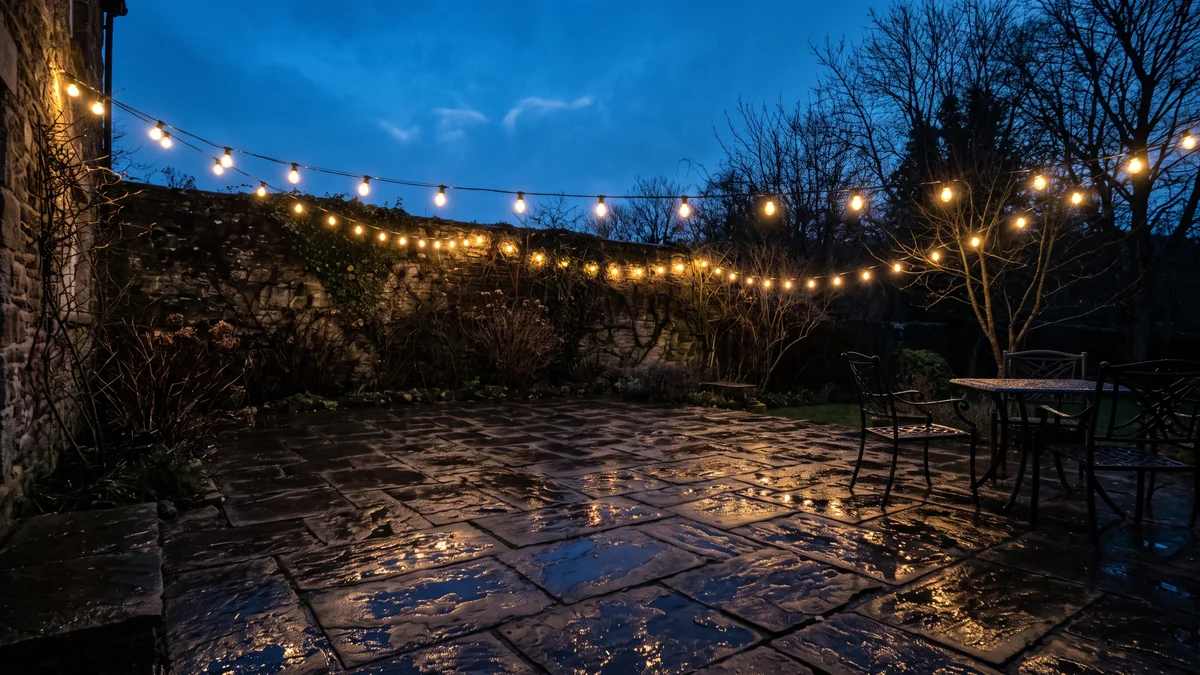
Lighting that was faultless all summer often dies in a fortnight between November and February. The frost gets blamed, or the rain. In practice the water arrived from an unexpected direction, and it was usually inside the housing before the first cold night.
Water climbs in, it does not fall in
Rain landing on the top of a sealed fitting causes the fewest failures. Two quieter routes do the damage.
The first is the cable. Outdoor flex is stranded, and the channels between those strands act like a bundle of drinking straws. Nick the sheath under a clip, or leave a cut end lying in a border, and water is drawn along inside the cable by capillary action. It travels metres, and it can surface at a terminal two metres up a wall while the gland is still tight.
The second is the air already in the housing. A lamp warms when it is on and cools when it goes off, so the air inside expands and contracts and draws damp evening air past the seals. Overnight that moisture condenses on cold glass and runs onto the terminals. One night is nothing. Ninety nights is a green terminal and a fitting that flickers, then stops.
What the IP number is telling you
An IP rating is two digits. The first is solids and dust, the second is water. Outdoors, only the second is worth arguing about. An X means that digit was never tested.
| Rating | Tested against | Where it belongs |
|---|---|---|
| IPX4 | Splashing from any direction | Under a deep soffit or a covered porch |
| IPX5 | A low pressure jet | Wall fittings on a sheltered elevation |
| IPX6 | A powerful jet | Open terraces and exposed walls |
| IPX7 | Immersion in one metre of water | Spike lights, deck lights, anywhere a puddle forms |
Two things get forgotten. The rating is measured on a new fitting, assembled properly, with the gland tightened onto a cable of the diameter it was made for. Put a thin cable through a gland sized for a fat one and the rating is gone. And it covers the fitting alone, not the joint you added halfway along the run, which is where most installations let go.
Drip loops, and which way up the gland goes
A drip loop is the cheapest reliability you can buy. Rather than take the cable straight into the fitting, let it hang below the entry point and come back up. Water running down the sheath reaches the bottom of the loop and drips off there. Ten seconds, and a hundred millimetres of cable.
The second rule is shorter. Never mount a fitting with the cable entry pointing up. Water gathers on the shoulder of the gland and works past a seal meant to shed it, not to hold a puddle. Once inside, the body of the fitting is the lowest point, so nothing drains out. Gland down, or tipped slightly down.
Seal it or drain it, never both
There are two honest designs for an outdoor fitting. One is fully sealed and potted, with no way in and no way out. The other is vented on purpose, so whatever condenses inside runs out of a weep hole at the bottom. Both work. Mixing them kills fittings.
The usual mistake is spotting a small hole in the underside of a housing, taking it for a defect and filling it with silicone. That hole was the drain. Sealed up, the housing becomes a cup and a winter of condensation sits on the terminal block. Drill your own at the true lowest point as mounted, and check each autumn that it is clear.
Solar against mains, told straight
Solar avoids a spur, a trench and an electrician, and from March to October across most of Europe it does the job. Lamps where you want the light, panel where the sun is.
Winter is a different story. A panel needs direct light, not general daylight. In late December at fifty degrees north the sun is low, weak and often behind cloud, and a panel under an eave or behind a shrub sees almost nothing usable. Cold cells take charge poorly too. Expect an hour or two at midwinter, not a full evening, and mount the panel where you can reach it to wipe, angled up rather than flat.
For light you can rely on at five on a January afternoon, the answer is mains. That brings obligations: a residual current device, accessories rated for the position, and in most member states work a qualified electrician should certify.
Routing and burying cable
Surface cable wants to follow something solid: a fence rail, a wall, the edge of a deck. Clip it, never staple through it, and keep it clear of the mower line. Where a run crosses open ground, bury it properly or not at all.
- Ordinary flex never goes straight into soil. Use armoured cable, or ordinary cable inside a continuous duct.
- Around 450 mm of cover under a lawn or a border, 600 mm under a drive.
- Bed it on sharp sand and lay marker tape roughly 150 mm above it.
- Photograph the open trench. In five years that is the only record of the route.
Colour temperature
Warm is the point outdoors. Between 2200K and 2700K flatters stone, brick and timber, and it reads as evening. Above 3000K a terrace looks like a delivery yard, and at 4000K brickwork turns grey. Several low, dim fittings washing a wall or a set of steps beat one bright flood, so aim light at surfaces rather than at eye level.
Closing the season down
Late October, before the weather turns, walk the run with a cloth and a screwdriver. Wipe the panels, check every gland is tight, and pull any lamp with condensation behind the glass. Look for green or white powder at the terminals.
If the run comes down, dry it before it goes in the box. A day in a warm room with the lamps out, then store it somewhere that does not swing between damp and freezing. More festoon sets are killed by being boxed up slightly wet in September than by anything the frost does in January. Leave solar batteries part charged, and bring the panel in with the lamps.
More write-ups on decks, paving and outdoor power.
Back to all projects